

Sigma-Delta and Pipeline Converters: High-Resolution, High-Performance Solutions
Lorenzo Martini, 05/09/2026
Introduction: The Evolution of Analog-to-Digital Conversion
In the landscape of analog-to-digital conversion, the Sigma-Delta (Σ-Δ) and Pipeline architectures represent two sophisticated approaches that have revolutionised what is possible in fields where traditional SAR and Flash solutions fall short. These architectures embody profoundly different but complementary strategies: on one hand, Sigma-Delta converters favour extreme resolution through oversampling and noise-shaping techniques; on the other, Pipeline converters optimise the trade-off between speed and resolution through segmented, parallel processing.
The strategic importance of these architectures has grown exponentially over the past decade, driven by the evolution of fields such as high-fidelity audio, wireless communications, medical imaging and precision instrumentation. In a world where the interfaces between analog and digital are becoming ever more critical, a thorough understanding of these technologies offers significant competitive advantages to designers and decision-makers alike.
In this third article of our series on analog-to-digital conversion (after the fundamentals and conversion principles and the SAR, Flash and hybrid high-speed architectures), we will explore the operating principles, advanced implementations, performance parameters and application domains of both architectures, providing a complete framework for choosing the most appropriate solution for specific design needs.
Sigma-Delta (Σ-Δ) Converters: The Art of Extreme Resolution
The Principle of Noise Shaping in Sigma-Delta Converters
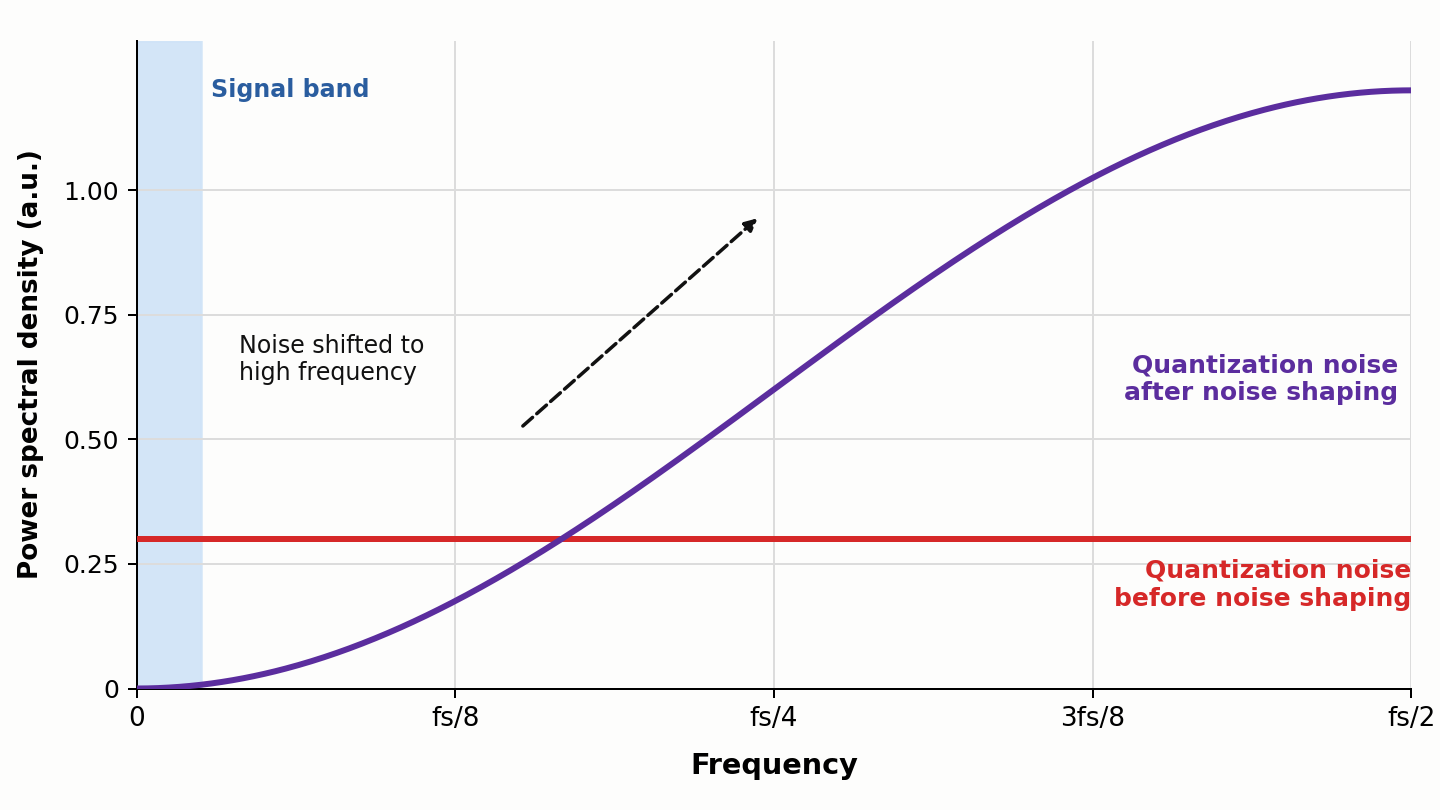
The diagram illustrates the fundamental principle of noise shaping in Sigma-Delta converters. With this technique, the quantization noise is not reduced in terms of total power, but is redistributed across the frequency spectrum.
The red line represents the uniform distribution of quantization noise in a traditional converter, where the noise is spread evenly across the whole frequency band.
The purple line shows the effect of noise shaping: the noise is “shaped” by a feedback system, moving most of its energy to high frequencies.
The blue shaded area represents the useful signal band, where the noise is greatly reduced thanks to noise shaping.
The high-frequency noise can then be removed by a digital decimation filter without affecting the useful low-frequency signal.
This principle, combined with oversampling, allows Sigma-Delta converters to reach extremely high resolutions (up to 24+ bits) while maintaining excellent linearity.
Oversampling and Noise Shaping
The Sigma-Delta architecture represents a radically different approach to analog-to-digital conversion compared with traditional solutions. Rather than trying to quantize every single sample with high precision, it implements a strategy based on two fundamental concepts:
-
Oversampling: The signal is sampled at a frequency much higher (8 to 512 times) than the minimum required by the Nyquist theorem, spreading the quantization noise over a wider band.
-
Noise Shaping: Through a feedback system, the quantization noise is shaped so that it concentrates at high frequencies, far from the useful signal band.
Basic Architecture
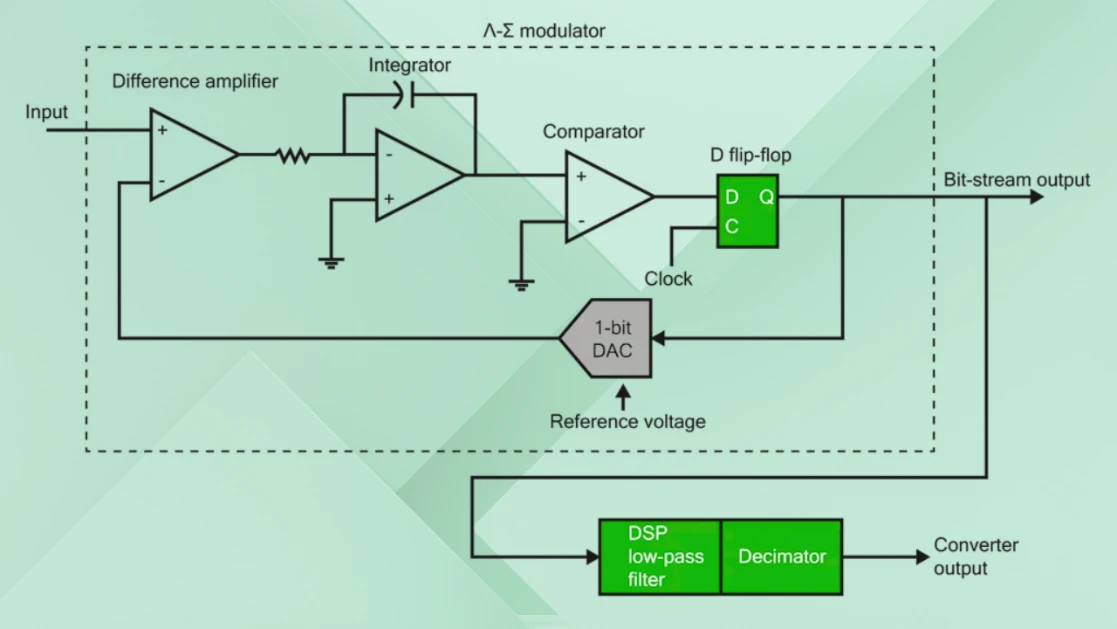
A first-order Sigma-Delta converter comprises four fundamental elements:
-
Integrator: Accumulates the difference between the analog input and the feedback from the quantizer.
-
Quantizer: Typically implemented as a 1-bit comparator that determines whether the integrator output is positive or negative.
-
Digital-to-Analog Converter (DAC): Converts the quantizer output into an analog signal for the feedback.
-
Decimation Filter: Processes the high-frequency bit stream, removing the high-frequency noise and reducing the sampling rate to the desired value.
The noise transfer function of a first-order Sigma-Delta modulator is:
NTF(z) = 1 − z⁻¹
This function (NTF = Noise Transfer Function) is expressed in the z-domain, a mathematical representation commonly used to analyse discrete-time systems, and implements a high-pass filter for the quantization noise, attenuating it in the band of interest and amplifying it at high frequencies. The formula indicates that the quantization noise is shaped with a zero at zero frequency (DC). The noise is therefore attenuated at low frequencies (near DC) and increased at high frequencies, according to the noise shaping technique described.
Higher-Order Modulators
To improve noise-shaping performance further, higher-order modulators have been developed:
Second-order modulator: Uses two cascaded integration stages, giving a noise transfer function of:
NTF(z) = (1 − z⁻¹)²
This results in a noise-shaping slope of 40 dB/decade, significantly improving the SNR in the useful band.
Modulators beyond second order: Extend this concept further with more integration stages, but require particular attention to stability. Third- to fifth-order architectures are common in commercial high-resolution implementations.
Multi-Bit Modulators
A significant evolution is represented by multi-bit modulators, which replace the 1-bit quantizer with a low-resolution ADC (typically 3–5 bits):
-
They reduce the intrinsic quantization noise
-
They improve system stability
-
They allow the OSR (Oversampling Ratio) to be reduced while maintaining the same performance
The trade-off is greater complexity of the DAC in the feedback loop, whose linearity becomes critical to overall performance.
Advanced Implementations
Modern implementations incorporate numerous advanced techniques:
MASH (Multi-stAge noise SHaping) Architectures: Combine several lower-order modulators to achieve performance equivalent to a higher-order modulator, with better stability.
Continuous-Time Modulators: Use continuous-time rather than discrete-time integrators, allowing higher operating frequencies and lower power consumption.
Dithering Techniques: Add controlled noise to improve linearity with small signals.
Digital Error Correction: Implement digital correction algorithms to compensate for non-idealities of the analog modulator.
Performance Characteristics and Limitations
Sigma-Delta converters offer unique characteristics in the ADC landscape:
Resolution: Extremely high, typically 16 to 24 bits, with implementations that can reach 32 bits in specialised applications.
Speed: Relatively low for very-high-resolution implementations, with useful bandwidths from a few Hz to tens of kHz. Speed-optimised versions can reach bandwidths of a few MHz.
Linearity: Excellent, with very low harmonic distortion, making them ideal for audio and measurement applications.
Power Consumption: Varies significantly with the implementation; there are versions optimised for low-power applications and others focused on maximum performance.
Latency: Generally high because of the decimation filtering process, which limits their use in real-time control applications.
The main limitation of Sigma-Delta converters lies in the fundamental trade-off between resolution, bandwidth and latency.
Application Case: Professional Audio Acquisition System
An emblematic example of an ideal application for a Sigma-Delta converter is a professional audio acquisition system for a recording studio.
Scenario: A multichannel audio interface for a recording studio requires the highest fidelity in capturing musical signals with extreme dynamic range, keeping distortion and noise at the lowest perceptible levels.
Implementation:
-
Fifth-order Sigma-Delta converter with a 5-bit quantizer
-
Oversampling ratio of 128× (starting from 192 kHz)
-
Analog front-end with a very-low-noise, high-impedance amplifier
-
Ultra-stable voltage references with thermal regulation
-
Advanced digital filtering with linear phase
Performance:
-
Effective resolution: 22 bits over the full audio band (20 Hz – 20 kHz)
-
Dynamic range: 126 dB (A-weighted)
-
THD+N: −112 dB (0.00025%)
-
Frequency response: 20 Hz – 20 kHz ±0.01 dB
This implementation captures the subtlest nuances of musical expression, from the delicate harmonics of a whispered piano to the dynamic power of a full orchestral section, with a fidelity that exceeds the limits of human perception.
Application Case: Precision Instrumentation for Biomedical Measurements
A further example of an application for Sigma-Delta converters is in precision instrumentation for biomedical measurements.

Scenario: A high-density electroencephalography (EEG) system requires the simultaneous acquisition of brain signals from 256 channels with high resolution and very low noise, while keeping power consumption low for prolonged operation.
Implementation:
-
Array of third-order Sigma-Delta converters with a time-multiplexed architecture
-
Configurable bandwidth: 0–100 Hz for clinical applications, extendable to 0–500 Hz for research
-
Front-end with programmable-gain amplifiers and integrated anti-aliasing filtering
-
Adaptive operating mode with reduced resolution for inactive channels
Performance:
-
Resolution: 24 bits (>20 bit ENOB in the band of interest)
-
Input noise: <1 μVRMS in the 0–100 Hz band
-
Common-mode rejection: >110 dB at 50/60 Hz
-
Power consumption: <5 mW per channel in high-resolution mode
This solution can detect even the subtlest electrical potentials generated by brain activity, enabling detailed functional mapping and the identification of diagnostic patterns that would be invisible with conventional acquisition systems.
Pipeline Converters: The Balance between Speed and Resolution
Operating Principle: Parallel Multi-Stage Conversion
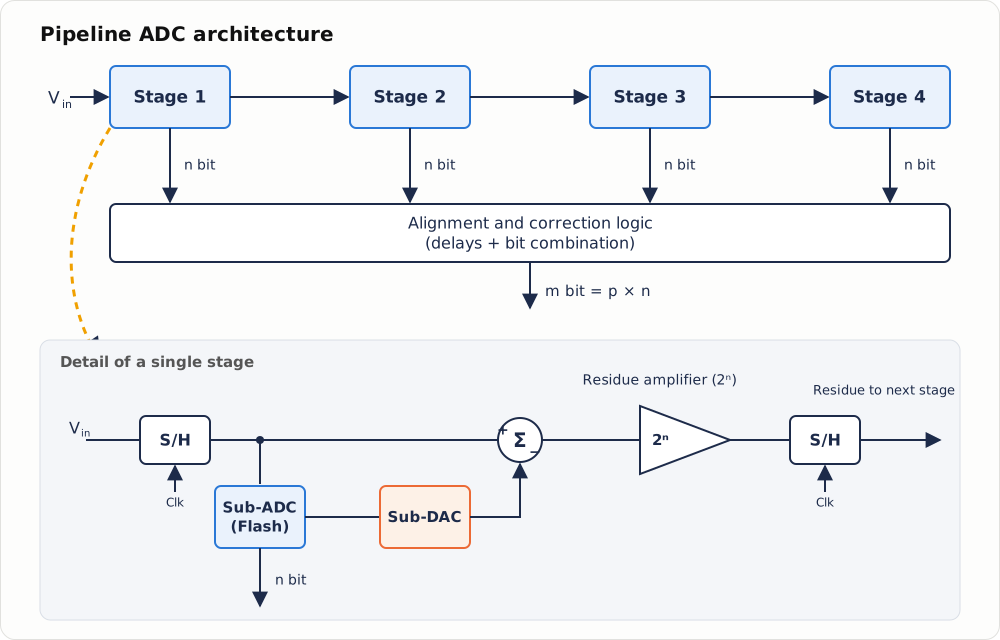
The Pipeline architecture implements a segmented conversion approach that distributes the quantization process over several stages operating in parallel:
-
The first stage performs a partial conversion (typically 2–4 bits) of the input signal
-
The partial result is converted back to analog by a DAC
-
The difference between the original input and the reconstructed value (the residue) is amplified
-
The amplified residue is passed to the next stage
-
The following stages repeat the process on their respective residues
-
The partial results are suitably delayed and combined to form the final result
This strategy delivers a high conversion speed while maintaining considerable resolution, placing Pipeline converters in a unique performance niche between SAR and Flash.
Basic Architecture
A typical Pipeline converter comprises the following elements for each stage:
-
Sub-ADC: A low-resolution converter (typically Flash) that quantizes the input or the residue
-
Sub-DAC: Converts the partial result into an analog signal
-
Subtractor: Computes the difference between the input and the reconstructed value
-
Amplifier: Amplifies the residue to use the full dynamic range of the next stage
-
Sample-and-Hold Circuits: Keep the signals stable during the various processing phases
The gain of the residue amplifier is typically equal to 2ⁿ, where n is the number of bits resolved by the stage.
Digital Correction Techniques
Pipeline converters are inherently vulnerable to gain, offset and non-linearity errors in the various stages. To compensate for these imperfections, digital correction techniques are implemented:
Redundant Signed Digit (RSD): Introduces redundancy bits that allow errors made by the sub-ADCs to be corrected, increasing the robustness of the system.
Digital Calibration: Measures and compensates the gain, offset and non-linearity errors of the various stages:
-
Factory calibration: Performed once during production
-
Self-calibration: Performed at device power-up
-
Background calibration: Continuous during normal operation
Time Interleaving: Increases the overall sampling rate by using several converters in parallel, each operating at a fraction of the total rate.
Advanced Implementations
Modern Pipeline ADC implementations incorporate numerous innovations to improve performance:
Low-Voltage Architectures: Optimised to operate with reduced supply voltages (1.8 V or lower) in nanometre processes, using operational amplifiers with bootstrapping and compensation techniques.
Switched-Capacitor Stages: Implement the sample-and-hold, subtraction and amplification operations using switched-capacitor networks, improving accuracy and reducing consumption.
Digital Compensation of Non-Linearities: Advanced algorithms that model and compensate non-linear behaviour in the various stages, extending performance beyond analog limits.
Dynamic Element Matching Techniques: Minimise the effects of component mismatch by rotating or randomising the elements.
Single-Opamp Architectures: Reduce complexity and consumption by implementing multiple functions with a single operational amplifier.
Performance Characteristics and Limitations
Pipeline converters offer a unique balance among the various performance parameters:
Resolution: Typically between 10 and 16 bits, with implementations that can exceed 18 bits using advanced calibration techniques.
Speed: High, from a few MSPS up to hundreds of MSPS in the fastest implementations, with interleaved versions that can exceed 1 GSPS.
Latency: Moderate, proportional to the number of stages in the pipeline, typically in the order of 5–10 clock cycles.
Power Consumption: Moderate, with a good compromise between speed and power drawn, typically in the order of pJ/conversion.
Analog Bandwidth: Generally wide, allowing direct digitisation of intermediate-frequency signals in many communication applications.
The main limitations of the Pipeline architecture lie in the complexity of implementation, the need for high-performance amplifiers, and the calibration challenges of maintaining accuracy at high speed.
Application Case: Acquisition System for Medical Imaging
An emblematic example of an ideal application for a Pipeline converter is a data acquisition system for computed tomography (CT).

Scenario: A new-generation CT system requires the simultaneous acquisition of signals from hundreds of channels with high resolution and high speed, in order to reduce scan time and the radiation dose to the patient.
Implementation:
-
14-bit Pipeline converter with an 80 MSPS sampling rate
-
Analog front-end with low-noise amplifiers and linear-phase anti-aliasing filters
-
Variable integration mode to adapt to different signal conditions
-
High-speed serial LVDS interface for data transfer
Performance:
-
ENOB: >12 bits up to 40 MHz input
-
SNR: >72 dB
-
SFDR: >85 dB
-
Power consumption: 250 mW per channel
This solution makes it possible to implement advanced reconstruction techniques such as multi-slice spiral CT or cone-beam tomography, significantly reducing scan times while maintaining excellent image quality. The reduction in exposure time translates directly into a lower radiation dose for the patient, a critical aspect in medical applications.
Application Case: Software-Defined Radio Receiver
A further application example for Pipeline converters is in the field of Software-Defined Radio (SDR) for telecommunications.
Scenario: A multi-band SDR receiver must digitise signals in different frequency bands (from HF to microwave) with sufficient resolution to discriminate weak signals in the presence of strong interferers.
Implementation:
-
12-bit Pipeline converter sampling at 200 MSPS
-
Direct-sampling or low-IF receiver architecture
-
Digital automatic gain control with a variable-gain amplifier
-
Digital processing in an FPGA for configurable demodulation and filtering
Performance:
-
Analog bandwidth: DC – 900 MHz
-
Dynamic range: 70 dB
-
Image rejection: >80 dB through digital I/Q processing
-
Interface: USB 3.0 or Ethernet for data streaming
This solution offers extreme operational flexibility, allowing the system to adapt to different communication standards (from AM/FM to LTE, WiFi and beyond) through simple software changes. The resolution and speed of the Pipeline converter are essential for implementing wideband receivers without compromising sensitivity or selectivity.
Comparative Analysis: Sigma-Delta vs Pipeline
The choice between Sigma-Delta and Pipeline architectures must be based on a careful analysis of the application requirements and the associated trade-offs. The following table offers a direct comparison of the main characteristics:
| Parameter | Sigma-Delta ADC | Pipeline ADC |
|---|---|---|
| Resolution | Very high (16–24+ bits) | High (10–16 bits) |
| Speed | Low-Medium (<1 MSPS at high resolution) | High (10–200+ MSPS) |
| Analog bandwidth | Limited (typically <1 MHz) | Wide (>100 MHz) |
| Latency | High (because of decimation) | Medium (proportional to the number of stages) |
| Power consumption | Can be very efficient | Moderate-High |
| Digital complexity | High (decimation filters) | Medium (correction circuits) |
| Analog complexity | Medium | High (precision amplifiers) |
| Jitter immunity | Medium-Low | High |
| Implementation cost | Medium | Medium-High |
In short, the main differences are these:
- Resolution: Sigma-Deltas excel with 16–24+ bits, against 10–16 bits for Pipelines.
- Speed: Pipelines dominate with 10–200+ MSPS, against less than 1 MSPS for Sigma-Deltas.
- Energy efficiency: Sigma-Deltas are more efficient per bit of resolution.
- Silicon area: Sigma-Deltas generally need less area for the same resolution.
- Latency: Pipelines offer moderate latency, against the high latency of Sigma-Deltas (due to decimation).
- Noise immunity: Sigma-Deltas are better at low frequencies, Pipelines at high frequencies.
- Analog complexity: Pipelines require more complex precision amplifiers.
- Digital complexity: Sigma-Deltas require sophisticated decimation filters.
Optimal Application Domain: Sigma-Delta
Sigma-Delta converters are the ideal choice when:
-
Extreme resolution is the priority
-
Precision instrumentation
-
High-end audio acquisition systems
-
Measurement of low-frequency physical quantities
-
Sensors with an extremely wide dynamic range
-
-
The signal bandwidth is relatively limited
-
Audio signals (<20 kHz)
-
Temperature, pressure and strain measurements
-
Electrocardiograms and electroencephalograms
-
Low-frequency vibration analysis
-
-
Latency is not a critical parameter
-
Monitoring systems
-
Data logging
-
Spectral analysis
-
Precision measurements
-
Detailed application example: A seismic monitoring system requires digitising signals from geophones and accelerometers with an extremely wide dynamic range (from microvolts to volts) over a relatively narrow band (0.01–100 Hz). A 24-bit Sigma-Delta ADC implementation with 256× oversampling achieves more than 130 dB of dynamic range, essential for detecting background microseisms and significant seismic events at the same time without saturation. The analog front-end includes chopper-stabilised, very-low-noise amplifiers (<10 nV/√Hz) and anti-aliasing filters with a precise cut-off at 100 Hz. Automatic calibration compensates for thermal drift, which is critical in remote installations with significant temperature excursions. These characteristics make the system capable of detecting both distant P-waves and local surface waves, essential for early-warning systems.
Optimal Application Domain: Pipeline
Pipeline converters are the optimal choice when:
-
A balance between speed and resolution is required
-
Wireless communication systems
-
Video signal processing
-
Radar and sonar
-
Medical imaging
-
-
The signal bandwidth is wide
-
Intermediate-frequency (IF) receivers
-
Real-time spectrum analysers
-
Automatic test systems
-
Digitisation of video signals
-
-
Latency must be contained but not minimal
-
Feedback control systems
-
Real-time multi-channel processing
-
Digital beamforming
-
Transient analysis
-
Detailed application example: An automotive radar system for driver assistance (ADAS) requires processing radar echoes in the 76–81 GHz band with enough resolution to discriminate nearby objects and enough speed to ensure adequate reaction times. After conversion to an intermediate frequency of 150 MHz, a 12-bit Pipeline ADC sampling at 250 MSPS digitises the signal for processing. The system uses an FMCW (Frequency-Modulated Continuous Wave) architecture in which the converter’s resolution directly affects the ability to discriminate objects of different reflectivity, while speed determines the maximum detectable distance and the ability to eliminate false targets caused by range ambiguity. The Pipeline ADC implements background digital calibration that compensates for the significant thermal variations of the automotive environment (−40 °C to +85 °C, non-engine zone). The overall latency of 40 ns allows real-time tracking algorithms to be implemented with reaction times below 10 ms, essential for emergency-braking functions.
Hybrid Architectures and Specialised Solutions
The continuing evolution of conversion technologies has led to the development of hybrid architectures that combine elements of different topologies to optimise specific performance parameters.
Band-Extended Sigma-Delta ADCs
These converters implement advanced techniques to extend the useful bandwidth while maintaining high resolution:
-
Parallel modulators: Use several Sigma-Delta modulators in parallel, each operating on a portion of the spectrum.
-
Quadrature techniques: Implement complex I/Q modulation to extend the useful band around non-zero frequencies.
-
Multi-band modulators: Implement noise shaping with multiple notches in the noise transfer function.
These techniques make it possible to build converters with bandwidths of a few MHz while maintaining resolutions above 16 bits.
Multi-Bit-per-Stage Pipeline ADCs
These implementations optimise the Pipeline architecture by increasing the number of bits resolved in each stage:
-
High-resolution first stages: Implement 4–6 bits in the first stages to reduce error amplification.
-
Adaptive calibration: Implement calibration techniques specific to each stage.
-
Selective interleaving: Apply interleaving only to specific stages of the pipeline.
These approaches make it possible to obtain resolutions of up to 18 bits while maintaining speeds above 100 MSPS.
Application Case: Wideband Receiver with a Band-Extended Sigma-Delta
Scenario: A spectrum-monitoring receiver requires the analysis of signals over a wide band (DC – 30 MHz) with high resolution, to identify weak signals in the presence of strong interferers.
Implementation:
-
Sigma-Delta converter with a sixth-order modulator and a 4-bit quantizer
-
Noise-shaping techniques optimised with multiple zeros in the NTF
-
Multi-stage decimation filters with adaptive rate reduction
-
Dynamic calibration of the multi-bit DAC in the feedback loop
Performance:
-
Resolution: 16 effective bits over a 30 MHz band
-
Dynamic range: >90 dB
-
Power consumption: 350 mW
-
Interface: JESD204B for high-speed data transfer
This hybrid solution makes it possible to implement very-high-performance SDR receivers, able to monitor LF, MF and HF bands simultaneously with sensitivity and selectivity superior to traditional receivers.
Technology Evolution and Future Trends
Recent Innovations
Over the past decade, both architectures have benefited from significant technological advances:
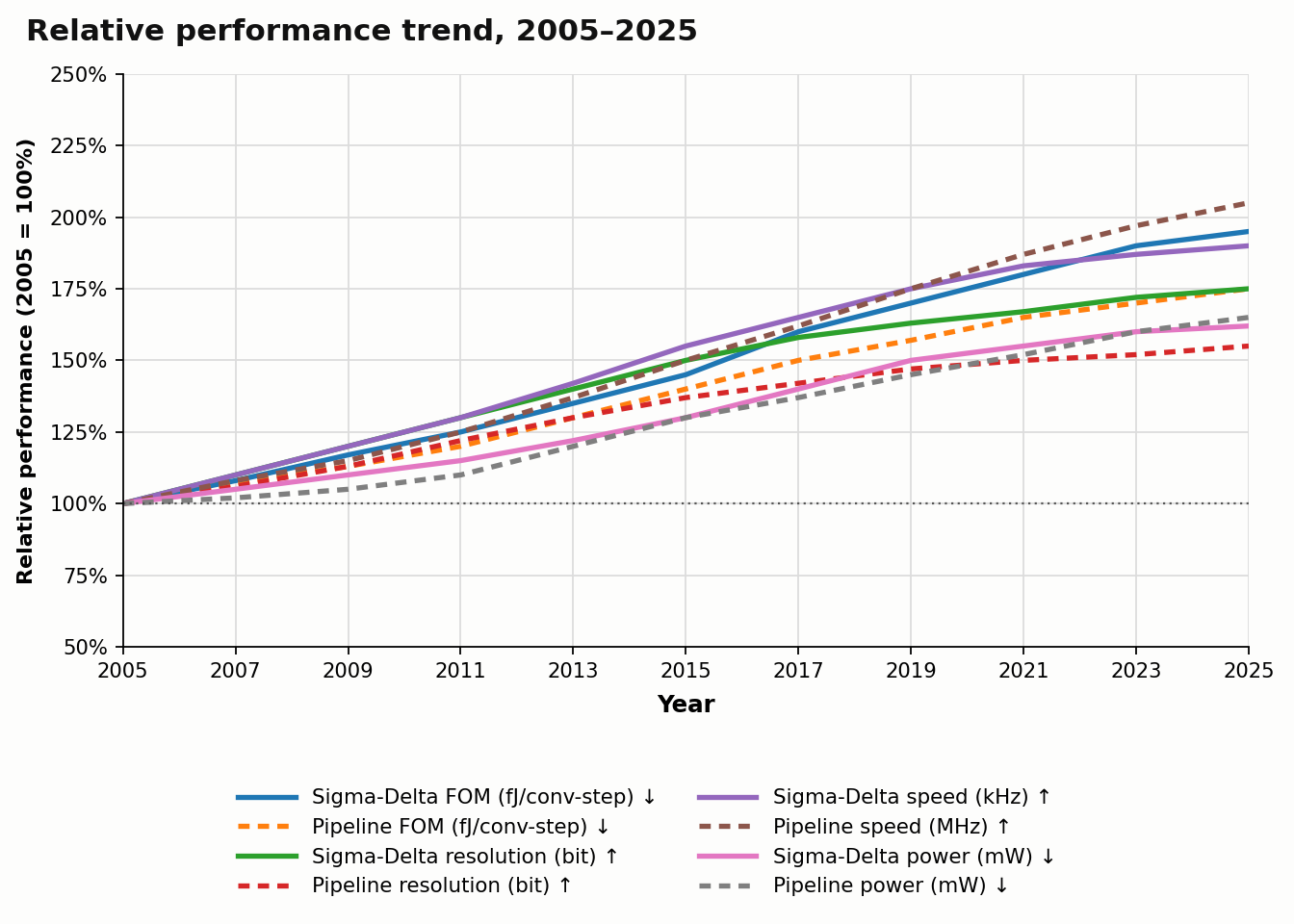
For Sigma-Delta converters:
-
Development of continuous-time (CT) modulators that extend the useful bandwidth
-
Implementation of hybrid modulators that combine discrete-time and continuous-time elements
-
Advanced noise-shaping techniques with NTF optimisation
-
Integration of self-test and self-calibration features
For Pipeline converters:
-
Implementation in nanometre processes with compensation techniques for low voltage
-
Development of residue amplifiers with dynamic calibration
-
“Opamp-sharing” architectures that reduce energy consumption
-
Background digital correction techniques to improve SFDR and linearity
Future Trends
Emerging application needs are driving some significant trends:
-
Wideband Sigma-Delta Converters: Extension of the useful bandwidth to tens or hundreds of MHz while maintaining resolutions above 14 bits.
-
Ultra-Low-Power Pipelines: Optimisation for mobile and IoT applications with an FoM <50 fJ/conversion-step.
-
Integration of Pre/Post-Processing: Incorporation of dedicated DSPs for functions such as FFT, filtering and detection directly on the converter chip.
-
Reconfigurable Architectures: Converters able to dynamically adapt parameters such as resolution, speed and power consumption to operating needs.
Technology Roadmap
In the next 3–5 years, we can expect:
-
Sigma-Delta converters with a bandwidth >100 MHz and resolution >14 bits for 5G and imaging applications
-
14+ bit Pipelines with speeds >1 GSPS for high-speed communications
-
A reduction in energy consumption of an order of magnitude through innovative circuit techniques
-
Greater integration with programmable analog processors for adaptive pre-processing
Economic and Implementation Considerations
Costs and Availability
The relative costs of the different solutions depend on several factors:
Sigma-Delta ADCs:
-
Price range: from $2–5 for consumer audio versions up to $50–300 for precision implementations.
-
Availability: a wide range for audio applications, more limited for extreme-precision versions.
-
Implementation cost: must include considerable digital resources for filtering.
Pipeline ADCs:
-
Price range: from $8–20 for basic versions up to $100–500 for high-performance implementations.
-
Availability: good coverage from the main semiconductor manufacturers.
-
Implementation cost: requires particular attention to layout and signal integrity.
System Considerations
Integrating these converters into a complete system requires attention to numerous aspects:
-
Power supply and references: High-resolution converters require extremely stable, low-noise supplies and references.
-
Signal conditioning: The analog front-end must be carefully designed to preserve signal integrity.
-
Clock jitter: Particularly critical for Sigma-Deltas, where it can significantly degrade performance.
-
Data handling: The high throughput of Pipelines requires high-speed digital interfaces and adequate buffering.
-
Thermal considerations: Thermal drift can significantly affect accuracy, requiring compensation techniques.
Guide to Selecting the Optimal Architecture
The choice between Sigma-Delta and Pipeline converters is a paradigmatic example of how application requirements determine the optimal technological solution.
There is no universally superior architecture, but rather an option better suited to each specific context.
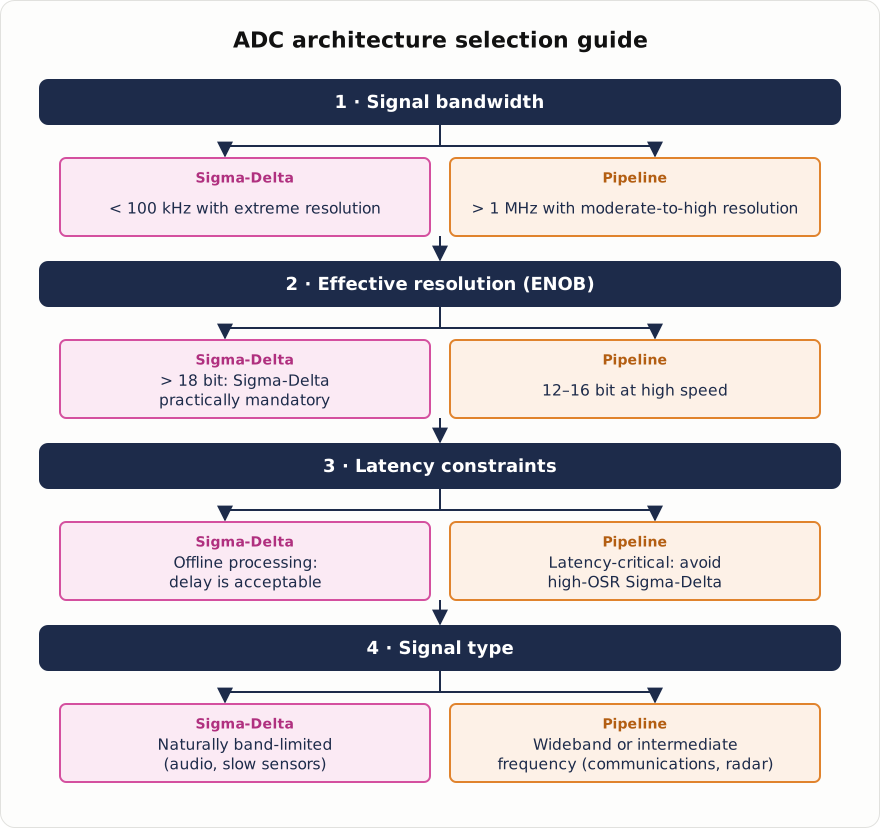
Decision Flowchart
The following decision process can guide the initial selection:
-
Determine the bandwidth of the signal to be digitised:
-
If <100 kHz with a need for extreme resolution, lean towards Sigma-Delta
-
If >1 MHz with a need for moderate-to-high resolution, consider Pipeline
-
-
Evaluate the effective resolution (ENOB) requirements:
-
If >18 bits, Sigma-Delta architectures are practically mandatory
-
If 12–16 bits at high speed, Pipeline offers the best compromise
-
-
Analyse the latency constraints:
-
For control systems where latency is critical, avoid high-OSR Sigma-Delta
-
For offline processing where delay is acceptable, Sigma-Delta can offer significant advantages
-
-
Consider the type of signal:
-
For naturally band-limited signals (audio, slow sensors), Sigma-Delta
-
For wideband or IF signals (communications, radar), Pipeline
-
Final Considerations
In the dynamic landscape of conversion technologies, it is essential to:
-
Evaluate the entire acquisition chain, not just the converter’s isolated specifications
-
Consider how application needs will evolve over time
-
Balance technical performance with considerations of cost, availability and support
-
Stay up to date with technological innovations that could alter the traditional trade-offs between architectures
The Sigma-Delta and Pipeline architectures will continue to evolve, amplifying their respective strengths and mitigating their inherent limitations. A thorough understanding of their fundamental characteristics remains an essential tool for designers and decision-makers in a world where the boundary between analog and digital is becoming ever more critical and strategic.
In the next article in the series, we will explore the practical aspects of implementing A/D converters, analysing the layout, interfacing, testing and characterisation considerations that are essential for achieving optimal performance in real applications.
Keep following us, because the journey through analog-to-digital conversion is not over yet!